

Introduction
Many couples share the same space, the same routines, and even the same bed. Yet, they may still feel a quiet distance they struggle to name. Conversations revolve around schedules, responsibilities, and daily logistics, but something deeper feels absent. The relationship looks intact on the surface, but emotionally, it feels incomplete.
That missing layer is often emotional intimacy. It is the part of a relationship that allows two people to feel truly known, understood, and emotionally safe with each other. While love may begin with attraction, shared values, or life circumstances, emotional closeness is what helps that love mature into a secure, resilient, and meaningful bond.
With it, couples build resilience, deepen trust, and create a connection that supports both their bond and their individual well-being. Without it, relationships may function, but they rarely flourish.
Key Takeaways:
Emotional intimacy allows partners to feel safe, understood, and accepted beyond surface-level connection. It helps couples share their inner thoughts, fears, needs, and hopes without feeling judged or dismissed.
Physical closeness and emotional closeness are related, but they are not the same. A relationship can include affection, attraction, and shared routines, yet still lack the deeper emotional safety needed for long-term fulfilment.
Signs of emotional distance can include surface-level conversations, avoidance of vulnerability, withdrawal during conflict, feeling unseen, or feeling lonely despite being together. These signs do not always mean the relationship is failing, but they do suggest that the emotional bond needs attention.
Couples can strengthen bonding through honest communication, attentive listening, intentional time together, consistent affection, and timely repair after conflict.
When long-standing patterns, trauma, or unresolved resentment are involved, professional support may help couples rebuild connection more safely and effectively.
An Overview of Emotional Intimacy
What Is Emotional Intimacy?
It refers to the ability to openly share your thoughts, fears, needs, and vulnerabilities with another person. It is characterised by emotional safety, which means feeling accepted rather than judged. Porges’ Polyvagal Theory helps explain why emotional safety is so important for intimacy. It suggests that the autonomic nervous system is constantly detecting whether a situation feels safe, threatening, or overwhelming. When a person feels safe, the social engagement system becomes more readily available. This makes it easier to listen, empathise, collaborate, and connect. In a close relationship, this allows both partners to express not only what they think, but also what they feel, hope for, struggle with, and fear.
Emotional closeness involves mutual understanding, trust, and honest communication. Partners feel “in sync,” connected not just by circumstance but by shared emotional awareness. This means there is enough safety in the relationship for each person to be emotionally honest without fearing rejection, ridicule, or punishment.
It also enables individuals to express both painful and joyful emotions without fear of rejection. A person may share sadness, insecurity, excitement, disappointment, shame, or hope, knowing that their partner will try to understand. This sense of psychological safety in relationships becomes one of the foundations for long-term closeness.
Emotional Intimacy vs Physical Intimacy: How They Differ
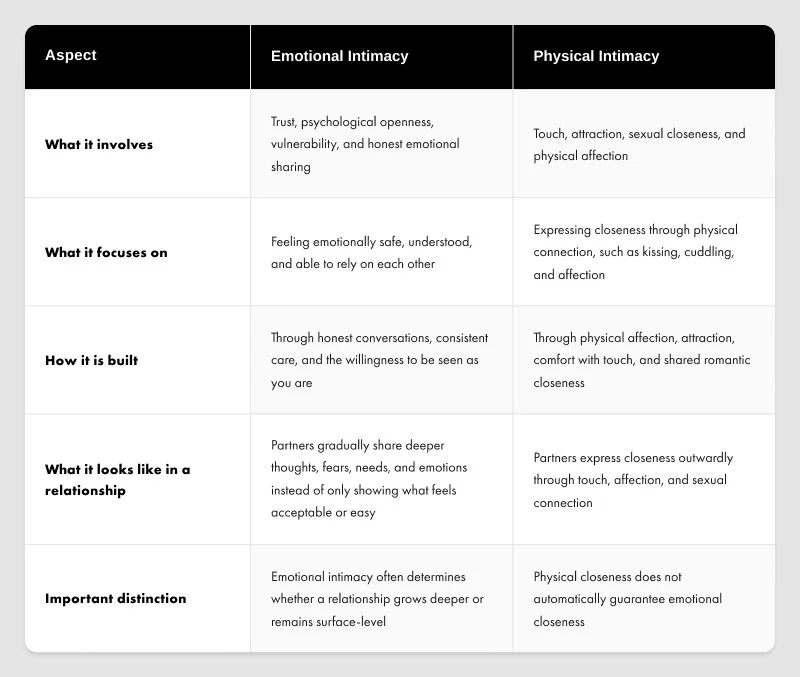
Couples often use the word “intimacy” to refer mainly to physical closeness. However, intimacy is broader than touch, attraction, or sexual connection. A couple may be physically affectionate while still struggling to speak openly about their fears, needs, or emotional pain. Understanding the difference helps couples recognise which part of their relationship needs attention.

Emotional intimacy involves trust, psychological openness, and vulnerability. It focuses on feeling emotionally safe and understood. This kind of closeness determines the depth and resilience of a long-term connection by shaping whether partners feel they can truly rely on each other emotionally.
Built through honest conversations, consistent care, and the willingness to be seen as you are, it includes vulnerability in relationships. In other words, both partners gradually share deeper parts of themselves instead of only presenting what feels acceptable or easy. Over time, this openness helps each person feel less alone.
On the other hand, physical intimacy involves touch, attraction, and sexual closeness. It includes affection such as kissing, cuddling, and physical connection. It often defines a romantic relationship outwardly because it is one of the most visible ways couples express closeness.
However, physical closeness does not automatically guarantee emotional closeness. Some couples may maintain physical routines while avoiding deeper conversations. Others may find that physical connection becomes strained when emotional safety is missing.
While both forms of intimacy matter, emotional intimacy often determines whether a relationship grows deeper or remains surface-level.
Why Emotional Intimacy Matters in a Relationship
A relationship may appear stable because there are few arguments, shared routines continue, and responsibilities are managed. However, if partners do not feel emotionally seen, the relationship can still feel lonely. Emotional closeness gives the relationship depth, security, and the ability to withstand stress.
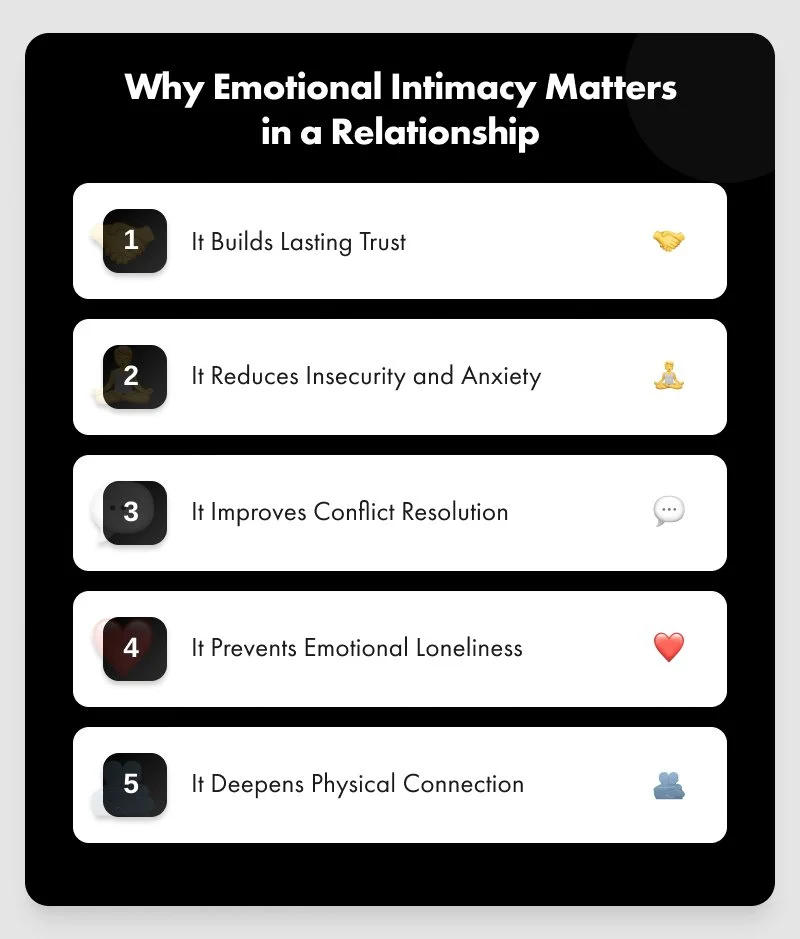
1. It Builds Lasting Trust
Trust is not built solely on loyalty or reliability. It is built when vulnerability is met with care. When one partner shares a fear, insecurity, past hurt, or personal dream, they are taking an emotional risk. If that disclosure is handled with empathy rather than criticism or dismissal, trust deepens.
Partners begin to believe:
“I can be honest here.”
“My feelings won’t be used against me.”
“I am emotionally safe with this person.”
When emotional connection is strong, partners can understand that honesty does not have to lead to distance. Instead, it can become a bridge toward greater closeness, relationship trust and emotional security.
2. It Reduces Insecurity and Anxiety
Attachment theory is a psychological framework for understanding the emotional bonds between people. It explains how early attachment patterns formed in childhood can shape trust, intimacy, emotional security, and behaviour in adult romantic relationships. These patterns are commonly understood as secure, anxious, avoidant, or disorganised.
Apart from partners who are securely attached, emotionally ambiguous situations could cause partners to feel a spike in anxiety. They may seek constant reassurance, overanalyse communication, or fear abandonment even in the absence of clear evidence.
Emotional intimacy provides reassurance not just through repeated verbal validation, but also through consistent emotional responsiveness. When partners respond to emotional bids, acknowledge each other’s feelings, and offer comfort during distress, they create a secure emotional environment.

Security reduces the need for excessive validation and lowers relational anxiety. Partners feel anchored rather than constantly seeking proof of love. This does not mean insecurity disappears completely, but it becomes easier to soothe because the relationship feels emotionally reliable.
3. It Improves Conflict Resolution
All couples experience conflict. The difference lies in how they approach it. When there is a strong emotional bond, disagreements are less about winning and more about understanding.
Partners are more likely to ask,
“What are you feeling?” “
What did this situation mean to you?”
“How can we repair this?”
Emotional connection softens defensiveness. It makes apologies more sincere and forgiveness more accessible. As the underlying bond feels secure, conflict is seen as a problem to solve together.
4. It Prevents Emotional Loneliness
It is possible to be in a committed relationship and still feel profoundly alone. When conversations remain surface-level and deeper emotions go unshared, partners may feel unseen despite physical proximity. Emotional loneliness often develops quietly and can erode satisfaction over time.
Emotional closeness creates genuine companionship. It allows partners to share internal struggles, personal growth, hopes and fears, and meaningful life reflections. These are the conversations that help couples feel they are moving through life together, not simply living parallel lives.
When this deeper layer is present, even ordinary moments can feel more meaningful. A simple conversation at the end of the day can become a place of comfort, understanding, and reconnection.
5. It Deepens Physical Connection
Physical intimacy is often stronger when emotional safety is established. When partners feel emotionally secure, they are less guarded and more open to closeness. Studies suggest that closeness between partners can benefit both emotional and physical health by activating the body’s natural bonding and stress-relief responses. Affection may increase levels of chemicals linked to comfort and connection, such as oxytocin, dopamine, serotonin, and endorphins, while helping reduce cortisol levels.
For many couples, emotional and physical closeness influence each other. As emotional distance grows, physical affection can start to feel forced or disconnected. In contrast, when emotional connection strengthens, affection often becomes more natural, comforting, and reassuring.
This does not mean every couple expresses closeness in the same way. In fact, it means that physical intimacy often becomes more meaningful when it is supported by trust, care, and emotional presence.
Strengthening Emotional Intimacy in a Relationship
What are the Signs of Emotional Intimacy in a Relationship?
These signs often show up in subtle ways, not just in dramatic moments of disclosure. They may appear in how partners listen, respond, apologise, comfort, and make space for each other’s inner world. When these qualities are present, the relationship usually feels more secure from within.
1. You Feel Safe Being Yourself
This safety matters because many people learn to edit themselves in relationships. They may minimise their needs, hide disappointment, or avoid sensitive topics to keep the peace. In an emotionally close relationship, both partners can be honest without fearing that honesty will automatically lead to rejection.
You can express difficult emotions such as sadness, anger, or fear without fear of humiliation or dismissal.
You feel accepted for who you are, not pressured to perform or hide parts of yourself.
You are comfortable sharing your inner thoughts, personal reflections, and deeper concerns.
2. Vulnerability Feels Natural, Not Risky
When emotional connection is strong, vulnerability does not feel like a dangerous exposure. It feels like an invitation to be known more fully. Partners still need sensitivity and timing, but the relationship has enough trust to hold difficult truths with care.
You can admit mistakes without feeling ashamed.
You openly discuss insecurities, past experiences, and emotional needs.
You confide in your partner rather than withholding important feelings.
3. You Feel Understood
Conflict does not automatically feel threatening. Feeling understood does not require your partner to share the exact same emotions or interpretations. It means they are willing to slow down and consider what the experience was like for you. This helps preserve the emotional connection between partners, even during disagreement.
Research also suggests that feeling understood can influence how people see themselves within a relationship. When a person feels deeply understood, they may be more willing to share private thoughts, emotions, and aspects of themselves with their partner. Over time, this can make the relationship feel more closely connected to their sense of identity, strengthening emotional closeness and the feeling of being “known” by the other person.
Your partner makes an effort to understand your perspective.
You feel heard and validated, even if you do not fully agree.
4. You Experience Emotional Security
Emotional security often feels calm. There is less guessing, less testing, and less fear that one difficult conversation will undo the bond. With this type of security, partners can grow as individuals while still feeling held within the relationship.
You feel supported in your goals, struggles, and personal growth.
You care deeply about your partner’s well-being and feel connected to their emotional state.
You can discuss future plans openly with a sense of shared direction.
5. You Feel Genuine Closeness
Genuine closeness often appears in small moments. These may include sharing a thought before anyone else hears it, laughing over something ordinary, or feeling comforted by your partner’s presence. These moments help emotional intimacy become part of daily life naturally.
You want to spend meaningful time together, not just out of habit.
You feel emotionally connected, not just physically close.
You find yourself looking forward to sharing experiences and special moments together.
What are the Signs That Emotional Intimacy May Be Lacking?
When emotional closeness is lacking, couples may not always recognise it immediately. The relationship may still function, responsibilities may still be managed, and conflict may not always be obvious. Yet, there may be an ongoing sense that something feels distant, muted, or emotionally unavailable.
1. Conversations Remain Surface-Level
Discussions focus mainly on logistics, routines, or external topics. Deeper emotional conversations feel awkward or are avoided altogether.
This can happen when partners become used to functioning as a team but stop relating as emotional companions. They may talk about bills, children, work, groceries, or schedules, but rarely speak about fears, needs, disappointments, or dreams. This pattern can gradually make the relationship feel practical but emotionally thin.
2. Vulnerability Is Limited or Avoided
When one or both partners avoid discussing feelings, personal struggles are often handled privately. There may even be hesitation to confide or open up. This emotional holding back does not always mean a partner is unwilling to connect.
Sometimes, it is a form of self-protection when they fear being misunderstood, judged, dismissed, or seen as too needy. Avoiding vulnerability may be a form of self-protection. When deeper feelings are consistently kept out of the relationship, emotional intimacy has little room to grow.
3. Emotional Disconnection During Conflict
Conflict becomes more painful when partners stop reaching for each other emotionally. Instead of trying to understand the hurt beneath the reaction, both may focus on proving a point or protecting themselves.
When partners withdraw emotionally during disagreements, defensiveness can quickly replace curiosity or understanding. This makes it harder to repair the hurt once the conflict has passed. Over time, unresolved conflict can create resentment and make closeness feel unsafe.
From an attachment perspective, even gentle feedback, criticism, or complaints can feel threatening when the relationship already feels emotionally ambiguous. The nervous system may not process the comment as neutral information, but as a possible threat to connection, safety, or belonging.

4. Feeling Unseen or Unheard
This can be especially painful because the relationship may look fine from the outside. Friends or family may see a stable couple, while one or both partners quietly feel emotionally invisible. When this continues, partners may stop sharing because they assume it will not make a difference.
Here are some common signs:
You do not feel understood by your partner.
You feel unsupported in important areas of your life.
You question whether your partner truly cares about your emotional experience.
5. Persistent Emotional Loneliness
Persistent loneliness can be one of the clearest signs that emotional connection needs attention. It does not mean love is absent, but it does suggest that the emotional bond is not being nourished in a way both partners can feel.
When this happens, partners may struggle to feel genuinely close, even when physically together. There is a lingering sense of distance or isolation within the relationship. At the same time, misunderstandings increase, and emotional reassurance feels limited.
How Can You Cultivate Deep Emotional Intimacy in a Relationship?
Establishing a deep connection requires intention, consistency, and emotional courage. It is not built by a single meaningful conversation alone, but by repeated choices to turn toward each other.
1. Practise Emotional Honesty
Emotional connection grows when honesty replaces emotional avoidance. This means learning to express feelings clearly, respectfully, and grounded in self-awareness.
For example, instead of saying, “You never care about me,” a partner might say, “I felt hurt and alone when I tried to talk earlier and we moved on quickly.” This kind of honesty gives the other person something real to respond to.
What you can do:
Share your feelings instead of suppressing them.
Express both positive and difficult emotions openly.
Communicate your needs clearly rather than expecting your partner to guess.
Allow yourself to be gradually vulnerable.
2. Listen to Understand, Not to Fix
Feeling heard is one of the strongest builders of emotional closeness. Many people do not need an immediate solution when they share something painful. They first need to feel that their emotions make sense to the person they love.
Listening well may sound like, “I can understand why that felt hurtful,” or “Tell me more about what that brought up for you.” These responses create space for deep connection by communicating care before correction.
What you can do:
Give your partner your full attention.
Validate their emotions before offering advice.
Ask thoughtful questions to understand their perspective.
Respond with empathy rather than defensiveness.
3. Create Safe, Distraction-Free Conversations
Emotional bonding deepens when partners feel fully present with each other. In busy lives, especially when work, family, and daily responsibilities are demanding, deeper conversations may not happen unless space is intentionally created. The Gottman Institute recommends finding a comfortable, private space without distractions, then taking turns to talk and listen. This gives both partners a clearer structure for sharing what they are feeling, what they experienced that day, or what they need from each other.
This does not always require long, formal conversations. Even 10 to 15 minutes of undistracted presence can help couples reconnect when the conversation moves beyond tasks into emotional truth.
What you can do:
Set aside intentional time without phones or interruptions.
Move beyond logistics into meaningful discussions.
Share personal reflections, memories, hopes, and fears.
Express appreciation when your partner opens up.
4. Repair Quickly After Conflict
Timely repair prevents resentment and reinforces trust. Couples do not need to avoid all conflict to have a strong relationship. What matters is whether they can return to each other with humility, care, and a willingness to understand.
Rebuilding trust in relationships often begins with repair. A sincere apology, a softened tone, or a willingness to revisit a painful moment can communicate, “Our connection matters more than my pride.”
What you can do:
Address hurt feelings early.
Focus on understanding, but not winning.
Offer sincere apologies when needed.
Reaffirm emotional connection after disagreements.
5. Show Consistent Affection and Appreciation
Consistent reassurance builds emotional security over time. Small gestures may seem ordinary, but they often carry deep emotional meaning. A kind message, a warm touch, or a simple “I appreciate you” can remind both partners that they are valued.
When appreciation becomes a habit, emotional bonding is strengthened in daily life. The relationship begins to feel less like a place of performance and more like a place of belonging.
Positive memories can also support emotional connection. A study suggests that savouring positive experiences in a relationship may help improve mood, strengthen optimism, and reduce relationship distress. This may include taking time to reflect on meaningful activities shared together, challenges both partners have overcome, or moments when one felt loved, supported, or cherished.
What you can do:
Offer small affirmations regularly.
Use nonsexual physical affection such as holding hands or cuddling.
Express gratitude for your partner’s presence and efforts.
End the day with shared reflections or appreciation.

The Role of Therapy in Rebuilding Emotional Intimacy
While many couples can strengthen emotional closeness through intentional effort, there are times when deeper intervention is needed. Repeated conflict, unresolved resentment, emotional withdrawal, trauma, or long-standing communication patterns can make it difficult to rebuild closeness without guidance. Relationship counselling and therapy provide a structured, confidential space to explore what is happening beneath the surface.
In Singapore, psychotherapy can be helpful when partners keep repeating the same cycle despite wanting change. One partner may keep reaching out while the other pulls away, or both may become defensive before either person feels truly heard. With gentle support, couples can slow these patterns down and learn healthier ways to respond to each other with care.
Therapy also supports emotional intimacy by creating a space where difficult feelings can be explored with care and structure. A trained psychotherapist in Singapore can help slow conversations down, identify patterns, and support both partners in expressing themselves more clearly. For some couples, having a therapist present can make vulnerability feel less frightening, as each person has room to speak, feel heard, and stay emotionally supported.
Effective couple counselling is not a quick fix. Through consistent sessions, couples can gain insight and develop healthier relational habits that lead to lasting improvement.
Frequently Asked Questions
1. How long does it take to build emotional intimacy?
It cannot be rushed but develops gradually through consistent honesty, empathy, and shared experiences. Trust builds over time as partners repeatedly demonstrate emotional safety and reliability.
2. Why do some people struggle with emotional closeness?
This may stem from past relational experiences, attachment patterns, trauma, fear of rejection, or difficulty expressing emotions. In some cases, couples therapy or counselling can help individuals understand and work through these barriers.
3. Can emotional intimacy be rebuilt after conflict or betrayal?
Yes, it can be rebuilt, but it requires intentional effort, accountability, and consistent repair. Honest communication, emotional validation, and sometimes professional guidance are often necessary to restore trust and security.
Conclusion
Attraction may spark a relationship, but emotional intimacy is what sustains it. It is the quiet, steady force that transforms chemistry into commitment and shared experiences into lasting partnership. This type of closeness allows couples to feel known, valued, and emotionally safe, even when life becomes stressful or difficult. It grows in everyday honesty, attentive listening, gentle repair after conflict, healthy communication in couples, and the courage to be vulnerable.
At The Psychology Practice, we provide compassionate, evidence-informed support for couples struggling to reconnect or individuals seeking greater emotional awareness. If emotional distance has become difficult to navigate on your own, our couple therapy counseling can help you understand the patterns beneath the disconnection and begin rebuilding a more secure, meaningful bond.
Contact us to begin a calmer, more honest path towards reconnection.