

Introduction
The silent treatment is a pattern of intentional or prolonged withdrawal from communication within a relationship. Instead of expressing thoughts or resolving conflict directly, one person may stop talking, ignore messages, or emotionally disengage, leaving the other partner uncertain about what has changed or how to respond.
According to research, our sympathetic nervous system can be activated when we perceive a threat to an important social connection. When a person senses rejection or disconnection, the body may respond with stress activation, while brain regions linked to pain processing may also become involved.
In many cases, avoidant communication is not simply about avoidance but reflects underlying emotional difficulty. It may stem from unresolved conflict, an inability to express feelings constructively, or a response to feeling hurt, overwhelmed, or misunderstood. Over time, this communication breakdown can create emotional distance and weaken the relationship's overall stability if not addressed effectively.
Key Takeaways:
The silent treatment differs from taking healthy space because it usually occurs without clarity, reassurance, or an intention to return to the conversation.
When silence is used repeatedly during conflict, it can create confusion, anxiety, emotional distance, and a weakened sense of trust between partners.
Some people use silence because they feel overwhelmed, struggle to express emotions, fear escalation, or have learned to avoid conflict as a familiar response.
Couples can respond more constructively by staying calm, creating a safe space for dialogue, setting boundaries around pauses, and agreeing on when to reconnect.
When avoidant communication becomes a recurring relationship pattern, therapy can help partners understand emotional triggers, rebuild communication, and strengthen emotional security.
Understanding the Silent Treatment
What Is the Silent Treatment?
It refers to a pattern of deliberately withdrawing communication from a partner during or after a conflict. This may include ignoring attempts to talk, refusing to respond, or emotionally disengaging without explanation, often leaving the other person uncertain about the situation.
While silence itself is not always harmful, it may become problematic when used as a behavioural response to conflict. In this context, silence ceases to be a neutral break and becomes part of the relationship’s conflict cycle. Instead of giving both people space to regulate and return to the issue more calmly, it may leave one partner wondering what went wrong, how their partner is feeling, or whether the relationship feels emotionally safe in that moment.
Maladaptive thought processes also appear central to understanding the onset and persistence of silence. A study showed that rumination and repetitive negative thinking about conflict were strongly associated with the use of both silent treatment and stonewalling. Individuals who overanalysed transgressions were more likely to withdraw communication, perpetuating emotional distance.
This can be painful because the receiving partner may be left wondering whether their partner needs space, feels hurt, or is pulling away. When it happens repeatedly, silence can become part of broader relationship conflict patterns that make future disagreements harder to manage.

Key Differences: Intent, Communication, and Emotional Impact
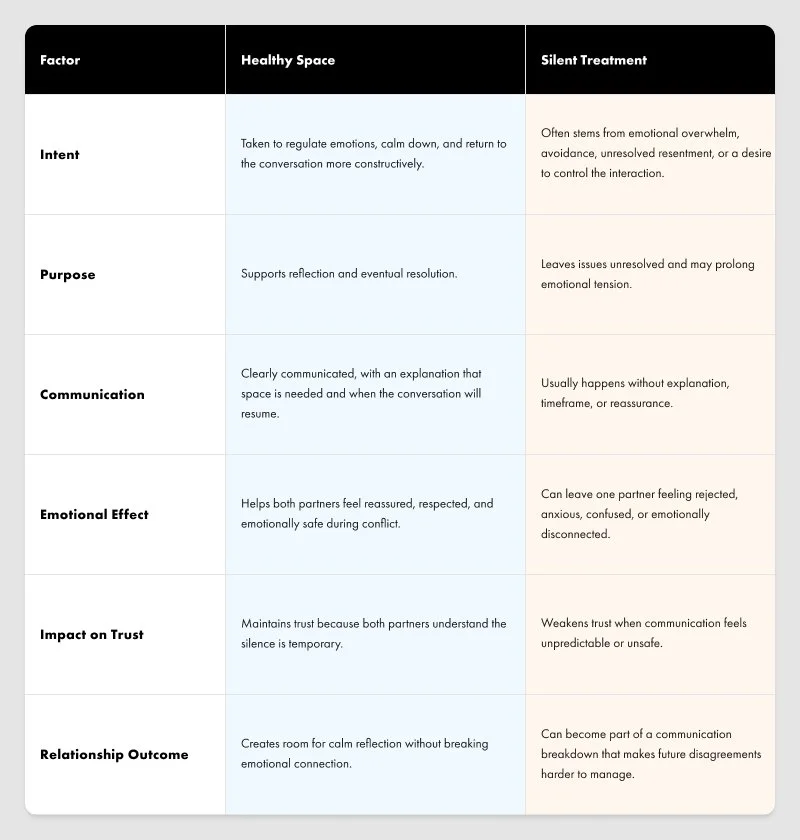
The difference between healthy space and the silent treatment is not simply about the presence of silence, but about how that silence is used within the relationship. Three key factors determine whether silence supports emotional regulation or contributes to relational breakdown.
1. Intent: Regulation vs Avoidance or Control
Healthy space is usually taken to regulate emotions during moments of intensity, not to avoid the issue. It gives both partners time to step back, regain clarity, and calm down before returning to the conversation in a more constructive way. As there is a clear intention to reconnect and resolve the issue, both individuals can feel more reassured, respected, and regain emotional balance and clarity.
In contrast, the silent treatment often lacks a clear or constructive intent. It may stem from emotional overwhelm, discomfort avoidance, or unresolved resentment. In some cases, a desire to exert control within the interaction. Instead of helping both partners move toward resolution, the silence can leave tension unresolved and make the relationship feel more uncertain.
This is why stonewalling, a defensive behaviour in psychology is often relevant when examining repeated silence in conflict. When a person shuts down completely, the behaviour may protect them from discomfort in the short term, but it can leave the relationship without the communication needed for repair.
2. Communication: Clarity vs Ambiguity
Communication is a defining factor in distinguishing the two behaviours. Healthy space is typically communicated openly, with an explanation that a break is needed and, importantly, when reconnection will take place. This clarity helps maintain trust, even during disagreement, because both individuals understand the silence is temporary.
Silent treatment, however, is characterised by a lack of communication. There is often no explanation, no timeframe, and no indication of when engagement will resume. This ambiguity leaves the other person uncertain, often leading to confusion, emotional distress, and attempts to interpret the silence without context.
When this becomes a recurring pattern of communication breakdown in couples, both partners may begin to anticipate disconnection whenever conflict arises. When communication has felt unpredictable, even small disagreements can spark worry, hesitation, or fear of being shut out again.
3. Emotional Impact: Safety vs Uncertainty
The emotional outcomes of each behaviour differ significantly. Healthy space tends to support emotional safety because it reassures both individuals that the relationship remains intact, even during conflict. It creates room for reflection without severing emotional connection.
The silent treatment, on the other hand, often produces emotional uncertainty. Without communication or reassurance, one partner may feel rejected, unsettled, or disconnected. If this continues, trust can slowly weaken, making it harder for both partners to speak openly.

Avoidant communication does not always look the same. It can appear in both subtle and more obvious ways. In many relationships, it is expressed through everyday behaviours that gradually reduce communication and emotional connection. While these actions may seem passive, they often carry a strong emotional impact on the receiving partner.
What are the Common Forms of Silent Treatment in Relationships?
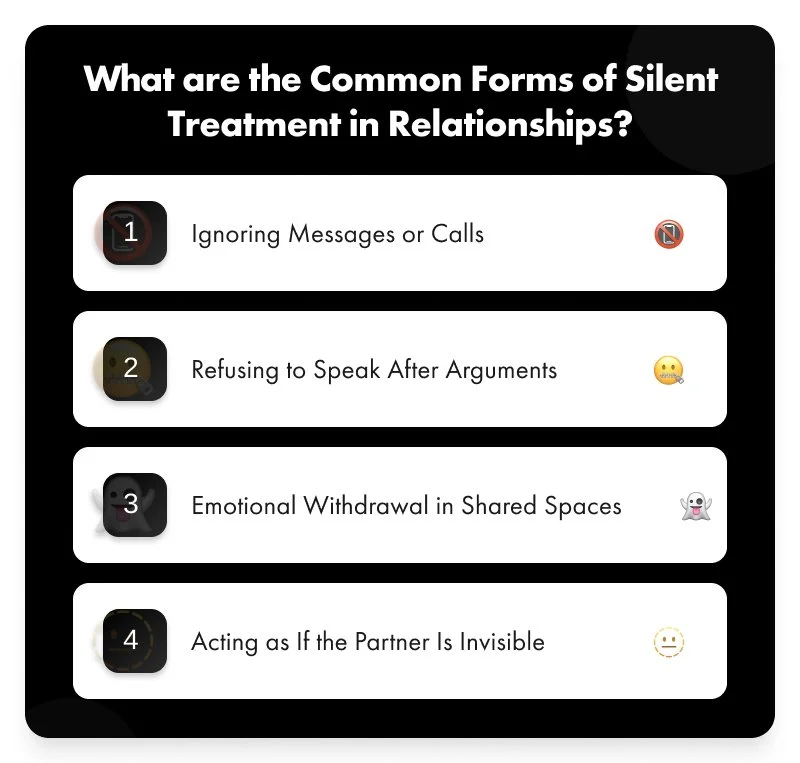
This type of treatment can show up in different ways depending on the relationship, the conflict, and each person’s emotional coping style. Recognising its different forms can help couples identify the pattern earlier.
1. Ignoring Messages or Calls
One of the most common forms is deliberately ignoring messages, calls, or attempts to communicate. This may involve leaving texts unread, not responding for extended periods, or consistently avoiding contact after a disagreement.
Over time, this creates uncertainty for the other person, who may not know whether the silence is intentional, temporary, or permanent. The lack of response often intensifies emotional distress and confusion, especially when no explanation is given.
2. Refusing to Speak After Arguments
Another frequent form occurs after conflict, where one partner completely refuses to engage in conversation. When this happens, communication is shut down entirely, sometimes for hours or even days.
This type of silence prevents resolution and leaves emotional tension unresolved. The absence of dialogue can also make it difficult for both individuals to understand what went wrong or how to move forward constructively.
3. Emotional Withdrawal in Shared Spaces
Avoidant communication can also happen even when both individuals are physically present. In these situations, one person may remain in the same space but withdraw emotionally, avoiding eye contact, interaction, or any meaningful engagement.
Although there is physical proximity, emotional distance becomes more noticeable. This form of emotional shutdown in relationships often heightens feelings of isolation, as the lack of interaction can feel more intense when both people are still in the same environment. Daily routines may continue, yet the emotional connection feels suspended.
4. Acting as If the Partner Is Invisible
In more extreme cases, emotional avoidance may involve treating the partner as though they are not present at all. This can include ignoring attempts to engage, avoiding acknowledgement, or behaving as if the other person does not exist in the shared space.
This form of emotional withdrawal in relationships can feel particularly distressing because it removes even basic acknowledgement within the relationship. It often leads to feelings of rejection and emotional disconnection, making repair and communication more difficult. Partners may also gradually suppress their own feelings to avoid triggering another period of silence.
The Psychological Reasons of Silent Treatment
Why Does Silent Treatment Happen?
It can happen for many reasons, and not every person who withdraws has the same intention. Some individuals are trying to protect themselves from emotional overload, while others may be avoiding accountability or trying to regain a sense of control. Identifying the reason behind the behaviour can help couples respond with greater clarity and direction.
1. Difficulty Expressing Emotions
Some individuals struggle to put their feelings into words during moments of conflict. Neuroscientist Stephen Porges’ polyvagal theory suggests that beyond fight or flight, some people may experience a shutdown response known as dorsal vagal shutdown. This is often described as one of the nervous system’s oldest survival mechanisms, which may activate when the brain perceives that fighting back or escaping is not possible. In this state, a person may find it difficult to speak, think clearly, or stay emotionally present.
When emotions such as anger, hurt, or frustration feel overwhelming, couples may lack the language or skills to express themselves clearly. In these situations, silence becomes a default coping mechanism. Rather than risk saying something they may regret or cannot fully articulate, they withdraw from communication altogether. While this may provide temporary relief, it often leaves the underlying issue unresolved.
2. Emotional Overwhelm
Intense emotional experiences can make it difficult for individuals to think clearly or respond constructively. When a person feels emotionally flooded, their ability to engage in rational conversation may temporarily shut down.
Withdrawing in these moments may feel like the only way to regain control and stability. However, without communication about this need for space, avoidant conflict response can become damaging. The silence can be misinterpreted as rejection or disengagement, which can increase tension within the relationship.
3. Avoidant Communication Style
For some individuals, emotional withdrawal is part of a broader avoidant communication pattern. When conflict feels too intense, they may respond by creating emotional distance instead of continuing the discussion.
This style often develops over time and may feel like a safer or more comfortable way to handle disagreement. However, repeated avoidance can make it harder for both partners to feel heard, understood, and emotionally connected. As a result, the relationship may lose opportunities for honesty, repair, and emotional understanding.
4. Learned Behaviour from Past Experiences
Communication habits are often shaped by early family environments or past relationship experiences. If silence, withdrawal, or avoidance were commonly used as a response to conflict, individuals may unconsciously repeat these patterns in their own relationships.
In such cases, shutting partners out is not always a deliberate choice but rather a familiar response learned over time. Without awareness, these patterns can continue even when they negatively affect current relationships.
5. Fear of Escalation
Some individuals use silence to prevent conflict from intensifying. When disagreements feel like they may escalate into arguments or emotional outbursts, withdrawing may seem like the safest option.
The intention can reduce tension at times, but the lack of communication may have the opposite effect. Without clarity or reassurance, the other partner can easily feel ignored or rejected, which can further escalate emotional distance.
What is the Psychological Impact of Silent Treatment?
The psychological impact of silent treatment can be deeply unsettling, especially when it happens repeatedly. Without explanation or reassurance, the receiving partner may be left trying to make sense of the silence on their own.
1. Emotional Confusion and Anxiety
Emotional confusion is one of the most immediate effects. Without clarity or communication, the receiving partner may struggle to understand what has changed or why communication has stopped.
This uncertainty often leads to anxiety, overthinking, and emotional distress. The lack of response can feel like rejection, even when no direct statement has been made, making it difficult to regain emotional stability until communication resumes. The person on the receiving end may begin replaying previous conversations, searching for clues, or trying to predict what will make their partner re-engage.
2. Impact on Self-Esteem
Repeated exposure to the silent treatment can begin to affect how a person views themselves within the relationship. When communication is withdrawn without explanation, individuals may internalise the silence as a reflection of their worth or behaviour.
This can lead to self-doubt, feelings of inadequacy, or questioning whether they are valued in the relationship. In some cases, it may also cause individuals to over-apologise or suppress their own emotional needs to avoid further withdrawal. When someone begins taking responsibility for deliberate silence, the relationship dynamic can become imbalanced.
3. Breakdown of Trust and Emotional Safety
Healthy relationships rely on consistent communication and emotional responsiveness. When silence replaces dialogue, it can weaken the sense of emotional safety between partners.
The unpredictability of when communication will resume can make it difficult for individuals to feel secure enough to express themselves. As time passes, this is likely to erode trust and make open communication feel riskier or more uncertain.

4. Long-Term Emotional Distance
If emotional avoidance becomes a recurring pattern, it can gradually create emotional distance within the relationship. Each unresolved moment can add to a growing sense of distance, especially when important feelings are left unspoken.
This ongoing distance can slowly weaken the sense that repair is possible. As unresolved tension remains, both partners may find it harder to believe that future conversations will bring comfort, clarity, or closeness.
How Silent Treatment Affects Relationships
The silent treatment affects more than individual emotions; it can also change how the relationship functions over time. When deeper issues are not properly addressed, couples may find themselves returning to the same arguments again.
1. Creates Emotional Distance
When a partner refuses to communicate, emotional closeness gradually weakens. The absence of communication creates a sense of disconnection. One or both individuals begin to feel unsupported or emotionally unavailable to each other.
In the long run, this distance can make it harder to re-establish normal communication, as emotional safety within the relationship becomes less stable. Even when communication resumes, the unresolved silence may remain in the background.
2. Increases Conflict Intensity
Silence does not resolve issues, but often leaves underlying concerns unaddressed. When communication eventually resumes, unresolved emotions tend to resurface. This can lead to heightened arguments, as both partners may carry accumulated frustration or confusion from the period of disconnection.
As a result, conflict cycles may become more reactive and emotionally charged. The argument is no longer only about the current disagreement but also about repeated experiences of being ignored, unheard, or emotionally alone.
3. Damages Communication Patterns
Healthy communication relies on openness, consistency, and mutual responsiveness. When silence replaces dialogue during conflict, these patterns begin to weaken.
Partners may find it more difficult to engage in calm, constructive conversations, as avoidance or withdrawal becomes a learned response. This shift can reduce the couple’s ability to resolve disagreements effectively. When one partner becomes more cautious and the other more withdrawn, a fragile dynamic forms unknowingly.
4. Leads to Cycles of Withdrawal and Pursuit
In many relationships, intentional silence creates a repetitive cycle where one partner withdraws while the other attempts to re-engage. This dynamic can create emotional imbalance, as one person seeks resolution while the other distances themselves.
Without intentional repair, this pattern can quietly strengthen over time. One partner may experience the pursuit as pressure, while the other experiences the distance as abandonment.
How Couples Can Respond to Silent Treatment
It is important not to ignore the behaviour completely, but pushing aggressively for immediate answers can sometimes intensify withdrawal. When both partners are willing to participate, these steps can help shift the relationship from avoidance toward repair.
1. Staying Calm and Avoiding Escalation
Responding to silence with heightened emotion or repeated confrontation can intensify the cycle of withdrawal. Maintaining emotional regulation allows space for more constructive engagement when communication resumes.
The focus should be on reducing escalation rather than forcing immediate resolution. This does not mean accepting the silent treatment as healthy. Instead, it means choosing a response that protects emotional safety and avoids deepening the conflict in the moment.
2. Creating Safe Space for Dialogue
Re-establishing communication is most effective when it is approached with openness rather than blame. Encouraging dialogue in a calm and non-threatening manner helps reduce defensiveness and increases the likelihood of reconnection.
This keeps the focus on understanding the pattern, not blaming the person. A warmer phrasing may be, “I want to understand what happened, and I hope we can find a gentler way to reconnect after difficult moments.”

3. Setting Healthy Communication Boundaries
Clear boundaries around communication during conflict can help prevent repeated cycles of silence. This may include agreeing on how space is used, for how long, and when reconnection will occur.
Boundaries provide structure and reduce uncertainty, supporting healthier relational dynamics over time. For instance, couples may agree that either person can request a pause, but the pause should include a timeframe and a commitment to return to the issue.
Healthy boundaries also encourage autonomy and reduce codependent habits. In a relationship, codependency may develop when one partner feels responsible for constantly managing, rescuing, or meeting the other person’s emotional needs at the expense of their own. Clear boundaries help both partners recognise where their own responsibilities begin and end, making it easier to offer support without taking on a self-sacrificing role or enabling unhealthy patterns.
4. When to Seek Professional Help
When the silent treatment becomes a recurring pattern that affects emotional well-being or relationship stability, professional support may be beneficial. Therapy can help identify underlying communication patterns and support healthier ways of managing conflict.
Working with a psychotherapist in Singapore can be helpful when the same cycle keeps repeating despite both partners wanting change. Professional guidance can support deeper understanding, especially when silence is linked to past experiences, emotional triggers, or entrenched relational habits.
How Therapy Helps Address the Silent Treatment
Therapy and couple counselling approaches can help couples move beyond surface-level arguments and understand the emotional patterns beneath them. The goal is not simply to make one person speak more quickly, but to help both partners understand what happens during conflict and why disconnection repeats.
1. Improving Emotional Expression Skills
Therapy provides a structured environment where individuals can learn to identify, understand, and communicate emotions more effectively. Through psychotherapy in Singapore, individuals may develop greater awareness of what they feel before, during, and after conflict. This can make it easier to express hurt, fear, anger, or disappointment without shutting down entirely.
2. Understanding Underlying Emotional Triggers
Silence is often linked to deeper emotional responses such as fear, overwhelm, or past relational experiences. Therapeutic work helps individuals explore these underlying triggers and understand why withdrawal occurs.
3. Rebuilding Communication Patterns
Therapy helps couples find more secure and compassionate ways to communicate. Approaches such as couples therapy counselling can help partners step back from blame and recognise the repeated cycle that is hurting the relationship. From there, both individuals can work together to change the pattern with greater understanding.
4. Strengthening Emotional Security in Relationships
Therapy can rebuild couples’ trust and emotional security by addressing repeated relational cycles and improving attachment dynamics. The goal is not only symptom reduction but long-term relational stability and resilience.

Frequently Asked Questions
1. How long is too long for silence in a relationship?
There is no fixed timeframe, but silence becomes unhealthy when it is prolonged without explanation or clarity about when communication will resume. A short pause taken to cool down can be constructive if both partners understand it is temporary.
However, when silence extends for hours or days without reassurance, it can shift from emotional regulation into emotional withdrawal. At that point, it often begins to affect trust, emotional safety, and the ability to resolve conflict effectively.
2. Can relationships recover from repeated silent treatment?
Yes, relationships can recover, but repeated silent treatment often signals deeper communication or emotional regulation issues that need to be addressed. Recovery depends on both partners recognising the pattern and being willing to change how they manage conflict.
With consistent effort, couples can rebuild trust, improve communication, and develop healthier ways to handle disagreements. In many cases, this involves learning to express emotions more directly and creating safer ways to take space without emotional withdrawal.
3. What should you do when your partner shuts down?
When a partner shuts down, it is important to avoid escalating the situation by repeating confrontations or applying emotional pressure. Giving space while maintaining a calm and open stance can help reduce defensiveness and allow emotions to settle.
Once communication resumes, focusing on understanding rather than blame is key. Setting clear expectations around how to take breaks during conflict can also help prevent repeated shutdown cycles and create a more stable communication pattern over time.
Conclusion
The silent treatment is often a reflection of greater emotional or communication difficulties. It typically signals challenges in emotional expression, conflict management, or relational coping patterns, rather than a straightforward unwillingness to engage. Understanding its underlying causes is an important first step toward improving communication and rebuilding emotional safety within relationships.
At The Psychology Practice, our psychological services are grounded in clinical depth, careful case formulation, and a strong therapeutic alliance. We understand that many couples do not seek support simply because of one difficult argument, but because the same painful patterns keep repeating despite their efforts to change.
For couples who are struggling with recurring silence, our relationship counselling provides a structured and supportive space to slow negative patterns down. We aim to help couples recognise the emotional cycle between them, rebuild trust, and move toward clearer communication and a healthier connection.
Reach out to us to begin meaningful repair.