

As the year comes to an end, we are invited to begin again. The shops fill with planners, social media fills with resolutions, and the unspoken message is that a new year is a clean slate, ready for whoever is brave enough to start.
But for many of us, the end of the year does not feel quite like the end without having finished the last one. A job that quietly stopped feeling like ours, a friendship that drifted, a version of ourselves that no longer fits, a season of life that is closing whether we are ready or not. We are asked to step into something new while still standing, in some part of ourselves, in what came before.
This is where an idea from the organisational consultant William Bridges can be useful to help us understand the experience of change. For many, beginnings and endings are seen as opposites. However, through his idea, the ending is the beginning.
Change is external. Transition is internal.
Change and transition are different things, and confusing them is why so many people feel stuck after a "good" change.
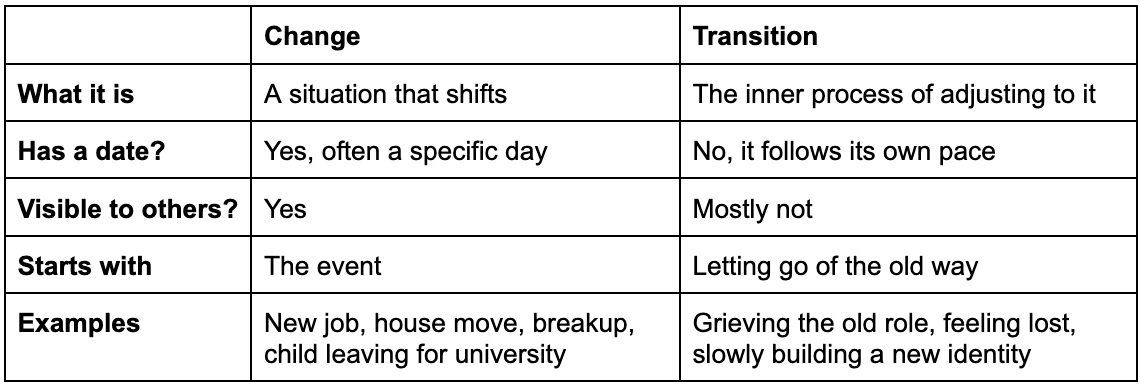
Two people can face the same change and have very different experiences. One has already done much of the inner work and moves forward with ease. The other has changed jobs on paper but is still, emotionally, in the old office. The event does not wait for the inner process to catch up.4
Three phases, in an order that matters
Transition was conceptualised as moving through three overlapping phases, and the order is the whole point.
An ending. Transition begins with letting go. This is the phase most of us skip, because it feels like loss and nobody schedules time for it. It involves releasing a role, a routine, an identity, or a hope, and often a quiet grief for something that may not have been perfect but was ours. Disorientation, sadness, irritability, and a sense of being unmoored are common here, and they are not signs that something is going wrong.
A neutral zone. After the ending comes an in-between stretch where the old way is gone and the new one has not yet formed. It can feel empty, confusing, or restless. Many people treat it as a problem to be solved quickly, but Bridges saw it as the place where real reorientation happens. It is uncomfortable largely because it is unfinished, not because anything is broken.
A new beginning. Only after the first two phases does a genuine beginning take hold, and it is more of an inner shift than a decision. It shows up as renewed energy, a clearer sense of direction, and a feeling that the new situation is becoming yours.
Notice what the usual year-end advice does. It speaks almost entirely to the third phase, with goals, plans, and fresh starts, and treats the first two as obstacles to skip past.
Why we skip the ending
Most of us skip the ending because our environment rewards forward motion and leaves little room to look back.
"What's next?" culture. After a change, people ask about the next step, rarely about how we are with what just finished. A job change is met with congratulations, a new school year with talk of the next exam, a break-up with "get back out there".
No permission to grieve good news. A promotion, graduation or move to a bigger home is supposed to be positive, so missing what was left behind can feel ungrateful. Chosen and "successful" endings are often the least acknowledged.
Short-term relief. Sitting with sadness or uncertainty is hard, while a new project or a packed December calendar offers instant relief. The ending is not resolved this way, only postponed.
The fresh start effect. Commonly, people are more motivated to pursue goals after "temporal landmarks" such as a new year. The surge of motivation is real, but it does not process the loss underneath it.
Common endings that may be overlooked
End of the academic year, graduations and exam results
Contract non-renewals, year-end reviews and role changes
Friends, family or colleagues relocating overseas
Children leaving home for study abroad
Relationships that have been quietly ending ahead of festive family gatherings
What an unfinished ending can look like
An unprocessed ending tends to travel with us into the next chapter, often in forms that we may not even recognise.
Feelings
Flat, irritable or tearful at moments that seem out of proportion
A vague sense of being "behind" or not ready, even when circumstances say otherwise
Relief and guilt, or gratitude and grief, at the same time
Thoughts
Constantly comparing the new job, home or relationship with the old one
Replaying conversations or "what if" scenarios
Difficulty talking about the past, or being unable to stop talking about it
Behaviour
Starting something new with forced energy that fades once the novelty wears off
Staying very busy so there is no quiet moment to feel anything
Avoiding places, people or reminders connected to the old chapter
None of this means something is wrong with you. It often signals that a part of us may still be in transition, waiting to be acknowledged, before moving to the next chapter.
Closing a chapter before the new year
Closing a chapter does not need a dramatic ritual, only some deliberate attention. Set aside 30 to 60 minutes this month and work through these six steps.
Name what is ending.
Complete the sentence: "This year, I am letting go of..."
Be specific, such as a role, a friendship, an expectation, or who you thought you would be by now.
Why it helps: putting feelings into words has been shown to reduce emotional intensity.
Make room for both sides.
List what the chapter gave you and what you will miss.
Allow gratitude and grief to sit together; neither cancels the other.
Why it helps: this mirrors the dual process model, where you face the loss and the future in turn.
Express yourself through art.
Try 15 minutes of expressive art like writing or painting about what happened, what it meant, and how it might have impacted you.
Why it helps: expressive art has been linked to better adjustment for some people.
Mark it with a small ritual.
Spend one last evening in a place that mattered, sort through objects from the old chapter, or share an honest goodbye with someone who was part of it.
Why it helps: rituals have been found to ease grief by restoring a sense of control.
Decide what you carry forward.
Ask: "What did this chapter teach me, and what do I want to keep?"
Why it helps: this builds a continuing bond and a coherent narrative, rather than a clean break.
Let the neutral zone be untidy.
Skip the grand resolution. Try two or three small experiments, such as a new walking route, a conversation you have been putting off, or an evening with no agenda.
Notice what feels like you, and let direction emerge from that.
A note on self-compassion. If you find yourself criticising how you are handling an ending, remember to treat yourself with the kindness you would offer a friend in the same position.
When it may help to talk to someone
Most endings settle with time, attention and the support of people close to us. Consider speaking with a therapist if:
Sadness, anxiety or emptiness is not easing after several weeks
It is affecting your sleep, work, studies or relationships
You feel stuck in a way that more effort alone does not shift
You find yourself avoiding anything connected to what ended
A past loss is resurfacing and feeling bigger than the present situation
Therapy offers a space to look honestly at what has ended and what it meant, so it is not carried unnoticed into the next chapter. If you are ever in crisis or worried about your safety, please contact emergency services or a crisis helpline straight away.
A different question for the end of the year: instead of "What will I achieve next year?", try "What is finishing, and what do I want to take with me?"