

Key Takeaways:
Eustress is a manageable form of stress that can support focus, motivation, confidence, and a sense of accomplishment.
The eustress graph shows that too little stress may reduce motivation, moderate stress can improve performance, and too much stress can lead to overwhelm.
Distress occurs when stress feels unmanageable, threatening, or beyond a person’s coping capacity.
Recognising the difference between distress vs eustress can help a person understand when psychological support may be helpful.
Introduction
Stress is often described as something negative, especially when it affects sleep, concentration, relationships, or emotional well-being. Yet psychology recognises that not all stress is harmful. The distinction between eustress and distress lies less in the event itself and more in how the situation is appraised, experienced, and managed.
Understanding distress vs eustress can help people recognise why some challenges feel motivating, while others feel overwhelming. A major life transition or important personal goal may energise one person but destabilise another. Whether stress becomes manageable or overwhelming depends not only on the situation, but also on how a person experiences and responds to it.
What Is Eustress?
Eustress refers to stress that feels challenging but manageable. It occurs when a person feels stretched, but still capable of responding to the situation in a meaningful and effective way.
Eustress often arises when there is a clear goal, a possible solution, or a challenge that aligns with something personally important. Preparing for an important presentation, taking on a new role at work, planning a wedding, managing a desired life change, or exercising at an appropriate level of difficulty may all involve eustress.
Although eustress can include nervousness, pressure, or temporary discomfort, it is usually accompanied by motivation, focus, and a sense of accomplishment afterwards. The person may feel tested, but not defeated. The challenge may require effort, but it does not feel impossible.
Eustress can strengthen confidence and resilience by allowing a person to experience themselves as capable under pressure. Over time, successfully meeting manageable challenges may build trust in one’s own emotional and practical resources.
The Key Concept of the Eustress Graph
The eustress graph helps explain the relationship between stress and performance. The X-axis represents stress level, while the Y-axis represents performance or effectiveness.
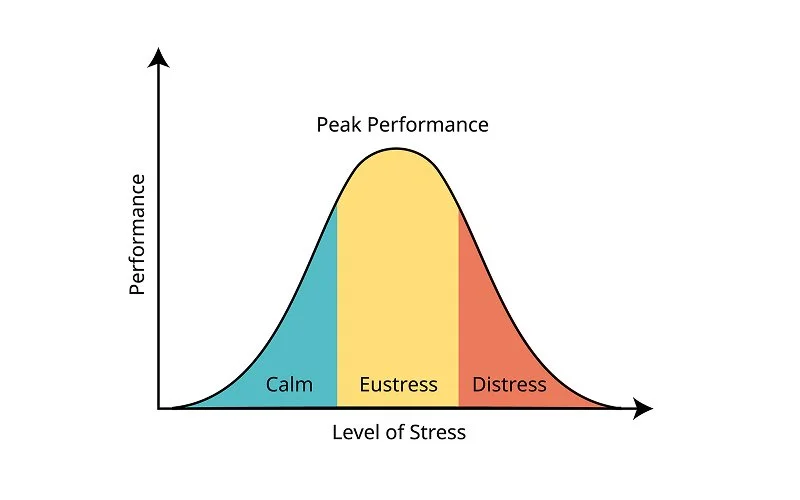
At very low stress levels, a person may experience boredom, lack of motivation, or reduced engagement. With moderate stress, performance tends to improve. This optimal stress zone is where eustress occurs. Challenges feel meaningful, energy increases, and focus becomes sharper.
When stress becomes too high, performance begins to decline. A person may feel overwhelmed, anxious, mentally fatigued, or on the verge of burnout. This is where stress shifts from helpful challenges into distress.
Stress and performance are closely linked, following a curved relationship.
Too little stress may lead to low motivation and reduced engagement.
Moderate stress can support focus, energy, and optimal performance.
Too much stress may reduce effectiveness and affect emotional well-being.
The goal is not to remove stress entirely, but to remain within the optimal stress zone where challenges feel manageable and meaningful.
What Is Distress?
Distress occurs when stress feels unmanageable, overwhelming, or threatening. Unlike eustress, distress is often linked to a sense of being under-resourced, unsafe, or unable to cope with the demands of the situation.
Distress can arise when a person feels out of control, when demands exceed their coping capacity, or when uncertainty and emotional strain continue for a prolonged period. Common examples may include relationship conflict, unwanted breakups, workplace bullying, toxic work environments, financial instability, loss, or bereavement.
Distress is more likely to involve anxiety, panic, hopelessness, emotional withdrawal, sleep disruption, appetite changes, irritability, or difficulty concentrating. Some people may become more reactive, while others may shut down or avoid situations that feel too difficult to face.
When distress becomes chronic, it can affect both psychological and physical well-being. Ongoing stress may influence mood, energy, attention, decision-making, relationships, and the body’s ability to rest and recover. Recognising distress early and seeking psychological services can help a person better understand the type of support they may need.
Why the Same Event Feels Different for Different People
The same event can feel exciting to one person and destabilising to another. When understanding distress vs eustress, an exam, relocation, career change, relationship transition, or new responsibility may feel like growth for one individual but like a threat to another.
Whether stress becomes eustress or distress depends on several factors. These include personal coping resources, past experiences, trauma history, support systems, personality structure, and current life demands.
A person with strong emotional support, sufficient rest, and previous positive experiences with similar challenges may appraise a stressful event as manageable. Another person facing isolation, unresolved trauma, or multiple pressures at once may experience the same event as overwhelming.
Stress is not inherently “good” or “bad.” Its impact depends on the internal and external conditions surrounding the person. What matters is how the person experiences the situation, what meaning they attach to it, and whether they have enough resources to respond.
Why Appraisal and Meaning Matter
Psychological research consistently shows that stress outcomes depend heavily on cognitive appraisal. This refers to how a person evaluates the demands of a situation in relation to their perceived resources.
Two individuals may face the same career change. One may see it as an opportunity for development, while the other experiences it as destabilising and risky. What differs is not the event itself, but the meaning attached to it. Appraisal is shaped by past experiences, attachment history, core beliefs about competence, current emotional state, and available social support.
When stress aligns with personal values and identity, it is more likely to feel energising. This is an important distinction between distress vs eustress. For instance, a demanding project may feel meaningful if it supports professional growth, personal purpose, or a valued relationship. When stress threatens self-worth, emotional safety, or stability, it can become distress.
When Distress Requires Support
While appraisal can sometimes shift stress toward growth, some situations exceed individual coping capacity. Distress does not always improve through positive thinking, rest, or time alone, especially when stress reactions are intense, prolonged, or connected to unresolved emotional pain.
Support may be helpful if:
Threat-based interpretations feel automatic and rigid
Stress reactions are disproportionate to the situation
Fear or avoidance repeatedly limits functioning
Past trauma amplifies present challenges
In such cases, the work is about reshaping how challenges are perceived, processed, and held emotionally. Seeing a psychologist in Singapore may support healthier coping, stronger relationships, and improved day-to-day functioning.
Moving From Distress Toward Growth
Therapy does not aim to eliminate all stress. Understanding distress vs eustress can help individuals see how some stress can encourage meaningful change, while prolonged distress may require deeper support. The aim is to help individuals understand their stress responses, strengthen emotional regulation, and develop a more stable relationship with pressure.
Therapy can support individuals in increasing self-awareness, processing unresolved trauma, building internal resilience, and recognising when manageable stress becomes distress. It may also help people identify patterns of avoidance, self-criticism, fear, or emotional shutdown that keep distress active.
At The Psychology Practice, our psychotherapists in Singapore offer depth-oriented, evidence- and practice-based psychotherapy tailored to your unique needs. With clinicians experienced in hospital and international settings, as well as trauma-informed treatment, we provide a supportive space to explore chronic distress, strengthen self-understanding, and build resilience.
If it has started to feel difficult to carry alone, talk to us about the support that may help you move forward.